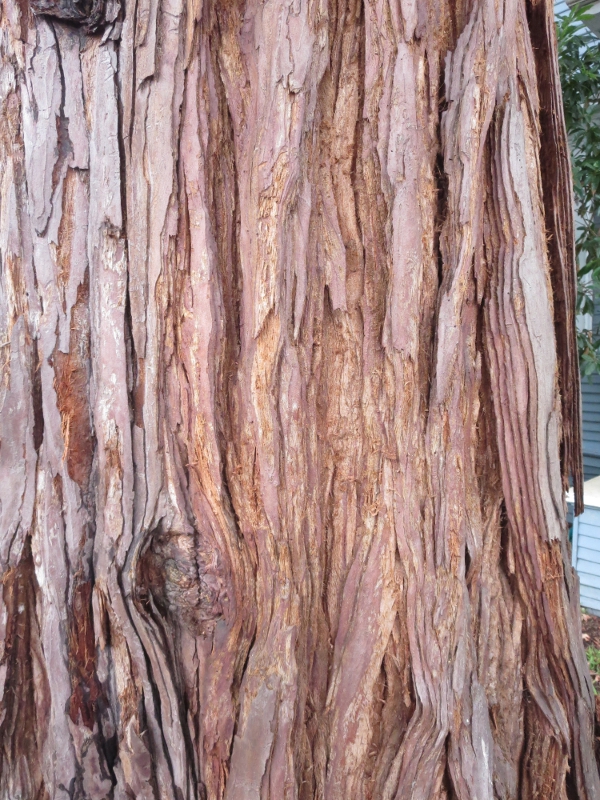
It's been a long while since I posted here ... too many distractions. But this morning, feeling kind of slow and walkabouty, I wandered east and north and west and south again, up to UC Berkeley's Campanile and back home. Here are some of the things I saw:
Sweet...
Related posts on One Finger Typing:
A day at Bodega Head
Post-convention blues (the sky, I'm sayin')
April showers brought May flowers
On the bright side: an iris in someone's front yard
Flowery front yards in Berkeley
Showing posts with label Berkeley. Show all posts
Saturday, June 24, 2017
Monday, February 1, 2016
Berkeley has its art museum back again: BAMPFA opens
The Berkeley Art Museum and Pacific Film Archive (BAMPFA) has opened in its new building, throwing a staged set of parties for donors, members, and the community at large. I visited for the first time on Saturday. Regular hours commence on Wednesday Feb 3rd -- regular hours are Wed-Sun 11am to 9 pm.
The expansive main gallery and the two film theaters promise a wealth of future visits that might even make up for the disappointment at losing the brutalist and endlessly compelling Mario Ciampi sprawl of BAMPFA's first home, of some 35 years.
Some bonus news: Babette, the café that was itself a destination at the old museum, has made the trek downtown with BAMPFA. It opens for business on Wednesday. At right, a view from the café balcony down into the museum's main gallery space.
Here's an excerpt of what SF Chronicle architecture critic has to say last week about the building in New home elevates BAMPFA status:
The image of one of four collaborations between Tomás Saraceno and some spiders doesn't come close to doing his haunting installation justice. Any one of the three pieces pictured is worth a visit to downtown Berkeley.
BAMPFA is one short block from the Downtown Berkeley BART station. Don't just come for the museum: take a walk on the campus, have dinner, taken in a play or a musical performance, and don't forget to circumnavigate the building in the evening to admire the shadow play on BAMPFA's metallic skin.
Related posts on One Finger Typing:
The Berkeley Art Museum is Dead - Long Live the Berkeley Art Museum!
Barry McGee mid-career survey at UC Berkeley art museum
Looking East at the SF Asian Art Museum: cultural appropriation or radical empathy?
Meet the Fishers
The expansive main gallery and the two film theaters promise a wealth of future visits that might even make up for the disappointment at losing the brutalist and endlessly compelling Mario Ciampi sprawl of BAMPFA's first home, of some 35 years.
Some bonus news: Babette, the café that was itself a destination at the old museum, has made the trek downtown with BAMPFA. It opens for business on Wednesday. At right, a view from the café balcony down into the museum's main gallery space.
Here's an excerpt of what SF Chronicle architecture critic has to say last week about the building in New home elevates BAMPFA status:
The shell of metallic scales is supple and soft, if not as crisply tailored as when first conceived. In morning sun the creased folds glisten; after dark, the trees along Oxford Street cast delicate shadows on the long panels. Rather than the dour tone of the copper-clad De Young Museum in San Francisco (not that there’s anything wrong with that), the streamlined tub has a cordial air.Here are three stunning pieces from the museum's inaugural show, "Architecture of Life," curated by museum director Larry Rinder:
As for the cantilever above Center Street, the red glow from the interior walls that was played up in renderings is barely discernible. Still, the outward gesture serves as a symbolic marquee above the lone public entry, while the corridor within the tail offers views into the galleries and gathering spaces below.
What you see is an interlocked, easily navigated realm far different from the choreographed ascension that offered one path through the 1970 museum. The corridor has two large entrances into the main gallery, where printing presses once churned beneath a saw-toothed roof that allows light in from the north. But first there’s a casual space dubbed the forum that cascades down, long wood stairs doubling as benches designed with an eye to events but also as a path leading to subterranean galleries.
At the end of the corridor, you face the belly of the beast — the rounded underside of the 232-seat main theater, the silvery metal skin continued inside as smooth gray stucco panels. The void between old and new serves as the theater atrium and is accented by a tall pointed glass wall facing the campus; there’s also glass that allows you to look down at the film archive’s library.
These visual connections are voyeuristic in the best sense. They’re also a nod to the communal air of the original museum, the way that the interior let you be part of something larger, an ever-changing show.
Portrait of My Father, Stephan Kaltenbach
4 Brushstrokes over Figure, Hyun-Sook Song
Solitary, semi-social mapping of ESO-510 613 connected with intergalactic dusty by one Nephila clavipes -- one week -- and three Cyrtophora citricola -- three weeks, Tomás Saraceno
The image of one of four collaborations between Tomás Saraceno and some spiders doesn't come close to doing his haunting installation justice. Any one of the three pieces pictured is worth a visit to downtown Berkeley.
BAMPFA is one short block from the Downtown Berkeley BART station. Don't just come for the museum: take a walk on the campus, have dinner, taken in a play or a musical performance, and don't forget to circumnavigate the building in the evening to admire the shadow play on BAMPFA's metallic skin.
Related posts on One Finger Typing:
The Berkeley Art Museum is Dead - Long Live the Berkeley Art Museum!
Barry McGee mid-career survey at UC Berkeley art museum
Looking East at the SF Asian Art Museum: cultural appropriation or radical empathy?
Meet the Fishers
Monday, January 11, 2016
Seasons blur as El Niño starts in on California
I live in Berkeley, California, and over the years have posted a lot of photos taken of my neighbors' front yards. Most often I've photographed the yards on Fulton Street, a residential street running north/south between my neighborhood and the southwest corner of the UC Berkeley campus (it's on my "walk to work" and "walk downtown" path).
Over the last week we've had some drier days and some wetter days as the rains associated with El Niño have begun. The new year, the pewter-gray skies, and the softened light has reawakened my attention to the plant life of local front yards, and to the odd blurring of seasons that January rains after four years of drought have brought on. So I thought I'd share some of what caught my eye this past week or so...
Here's Fulton Street, looking north. Doesn't seem so remarkable in a wide-angle view, does it?
But there are more seasonally ambiguous tableaux as well.
Blackberries and pears hanging on from summer and fall, respectively:
And then there are the jarring glimpses of early spring ...
... none more jarring than the early-blooming magnolia trees.
Thanks as always to Berkeley's many dedicated front-yard gardeners!
Related posts on One Finger Typing:
21 reasons it's not nearly so bad as it could be
April showers brought May flowers
Flowery front yards in Berkeley
Over the last week we've had some drier days and some wetter days as the rains associated with El Niño have begun. The new year, the pewter-gray skies, and the softened light has reawakened my attention to the plant life of local front yards, and to the odd blurring of seasons that January rains after four years of drought have brought on. So I thought I'd share some of what caught my eye this past week or so...
Here's Fulton Street, looking north. Doesn't seem so remarkable in a wide-angle view, does it?
Much of the neighborhood does look like winter, or the Bay Area's snow-free version of the season at any rate.
But there are more seasonally ambiguous tableaux as well.
Blackberries and pears hanging on from summer and fall, respectively:
And then there are the jarring glimpses of early spring ...
... none more jarring than the early-blooming magnolia trees.
Thanks as always to Berkeley's many dedicated front-yard gardeners!
Related posts on One Finger Typing:
21 reasons it's not nearly so bad as it could be
April showers brought May flowers
Flowery front yards in Berkeley
Tuesday, October 6, 2015
Sticking your neck out
I've had some interesting conversations lately about activist fiction. Yes, I have to acknowledge that those who focus on categorizing fiction might assume Consequence is aimed at a narrow demographic, fiction primarily written 'for' people who self-identify as political activists. But that's not how I conceived the novel, and early reviews on Amazon and Goodreads suggest my intention will be realized: that readers with much broader interests will feel rewarded once they find their way into its pages.
Given that the novel orbits a collective household of political activists, I think I ought to explain how and why I see a wider readership taking interest in it.
The thing is, I believe a broad, messy, scrappy variety of all kinds of people are quite a lot 'like' activists ... even though most would never think to call themselves that.
'Activist fiction', the way I read it, is a category of stories about people who are willing to stick their necks out.
Even if you're not that sort yourself, you probably know half a dozen people among family and friends who have stuck their neck out once or twice. Maybe you know people who stick their necks out regularly about some issue or problem or person they care about deeply. People who stick their necks out are legion, a ubiquitous part of our world. And when people stick their necks out, what they're up to is often pretty interesting. Captivating, even.
Here's my take from a 'sample interview' I drafted on the road to bringing out Consequence:
Q: What would somebody who isn’t politically active get from Consequence?
SM: Everybody decides how far to stick their neck out to confront the things they just can’t bear. Maybe you confront a school principal if your kid is getting bullied or shunned, or you go out of your way to buy something from a local business instead of on-line or from a national chain. Maybe you write a letter to the editor, or sign a petition, or support a political candidate who is trying to do something better than business as usual. Maybe you post an article or a meme about an issue you care about on Facebook or Tumblr or Twitter even if you expect it’ll rub some of the people you know the wrong way. Consequence is about people who are willing to stick their necks out regularly, around multiple issues, and to stick their necks out even further when hanging out in their comfort zone doesn’t get the results they’re after. I think most people can identify with that dilemma. Most of us go out on a limb about something we care about at some point in our lives, one way or another.
And another angle:
I swim regularly at the YMCA in Berkeley, and over many years I've met quite a few people outside my usual circles. Gyms are good for that. 'Everybody works out' may overstate the case, but you find a wide range of personalities in a gym that has 15,000 members.
One fellow-swimmer I talk with often is Jon P--, a commercial real estate broker, Rotarian, and grandfather. Recently, when I casually characterized Consequence in conversation as a novel about 'activists', Jon took sharp -- and well-considered -- exception. Not to the novel, which he hadn't read at the time. But to what he took to be my too-narrow definition of 'activist.'
"Look," he said, "everybody's an activist..." And then told me about a retired physician and member of the Berkeley Rotary Club who is in his mid-80s and remains passionate about eradicating polio. Bob, the physician, doesn't consider himself an activist, per se, Jon told me. People who know him don't think: oh, he's an anti-polio activist. People who know Bob see a doctor who has witnessed more than his share of suffering -- nature of the job, right? -- and is driven by empathy and compassion to do something to relieve a measure of that suffering.
So Bob works actively and passionately to accomplish a goal he holds to be a critically important public good.
Isn't that what activists do?
My friend Jon is right: maybe not everybody is an activist, but to draw a border between "activism" and passionate, goal-oriented activity aimed at realizing a public good -- that's not a very helpful or informative distinction. I'd venture the characters in Consequence would agree.
More or less everybody, sometime, sticks their neck out about something.
Related posts on One Finger Typing:
Radical conservatism vs the radical left
When authorities equate disobedience with violence
The Occupy Movement and UC Berkeley's Free Speech Monument
The desire to destroy is also a creative desire
Digging deeper holes
Thanks to Greg Willis for the image of giraffes, zebras, and springboks, via Wikimedia Commons.
Friday, March 27, 2015
21 reasons it's not nearly so bad as it could be
This morning I woke up a little bit blue, and -- until mid-day or so -- the overcast sky in Berkeley matched my mood. I took a walk around the neighborhood, and found a lot of good reasons to feel better. Here are twenty-one of them.
Just sayin' ...
April showers brought May flowers
On the bright side: an iris in someone's front yard
Flowery front yards in Berkeley
Labels:
Berkeley
Subscribe to:
Posts (Atom)