Monday, January 20, 2014

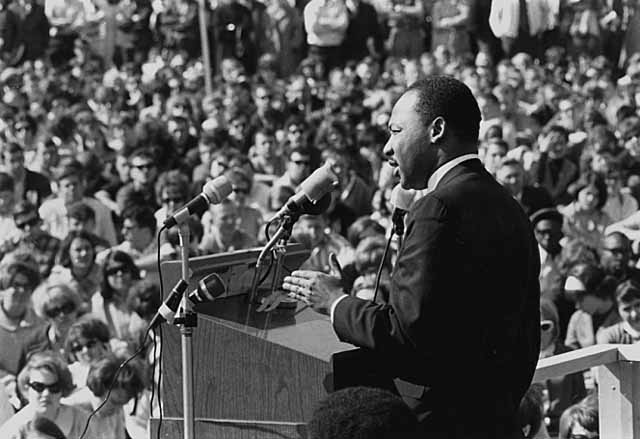
What Martin Luther King actually did

A Daily Kos diary by HamdenRice dated 29 Aug 2011 crossed my radar this morning (Martin Luther King, Jr. Day in the United States), thanks to a FB friend with whom I worked briefly in a Bay Area activist group (he now lives elsewhere). I have nothing to add to the unadorned link, below, other than the hope that more people read it because of this link than might otherwise find this piece.

The diary: Most of you have no idea what Martin Luther King actually did.

It's one of the most powerful accounts of how political activism transforms the world that I have ever read in the essay form.


Thanks to CJ for pointing me to HamdenRice's diary on Daily Kos; and to the Minnesota Historical Society and Wikimedia Commons for the image of Dr. King.

Wednesday, January 15, 2014

What Nelson Mandela actually said in Oakland on 30 June 1990

Nelson Mandela spoke at the Oakland Coliseum in June 1990 to a crowd of almost 60,000 people. It had only been a few months since his release, in February, from imprisonment of more than 27 years.

I was privileged to be there. Few occasions in my life have moved me as much as hearing Mandela personally and specifically address those of us who acted in solidarity with the struggle against apartheid in South Africa.

I'm writing about his speech today because for most of my adult life I misremembered -- and in two blog posts last year I misstated -- exactly what it was that Nelson Mandela said. (The two blog posts were Nelson Mandela and the death of UC Berkeley's Eshleman Hall and Eshelman Hall demolition: all but history.)

What I still remember -- incorrectly according to clear evidence -- is that Mandela mentioned the student organization I worked with as part of the anti-apartheid movement on the UC Berkeley campus, the Campaign Against Apartheid. I remember that he called the CAA out by name. But he didn't. What I remember didn't happen. That's humbling, and a valuable reminder of the fallibility of wetware.

Mandela referred to our struggle to force the obstinate Regents of the University of California to divest the university's holdings in companies that did business in South Africa, which was the struggle in which CAA vigorously participated; but he didn't mention our organization by name. The difference doesn't change the meaning and importance of Mandela's speech in my life; but I am corrected nonetheless.

I discovered my error when I hunted down video of Mandela's appearance at the Oakland Coliseum, shortly after he died last month. Here's the video, in a copy published to YouTube by Chingon Domino:


Mandela's speech begins at about 4'30", and concludes around 26'30" of the video.

Listening and watching to the footage several times, I made a transcript of Mandela's speech (another on-line transcript, posted on Inside Bay Area News and credited to Mercury News, contains a number of minor errors; I believe my transcription is more accurate). I'm including my transcript here, for the record.
Nelson Mandela, 30 June 1990, Oakland, California

Thank you. Thank you.

Mayor Lionel Wilson, Congressman Ron Dellums, distinguished officials of the cities of the Bay Area, sisters and brothers, comrades and friends. On my release from jail last Feb. 11, we walked out of the prison gates to a tumultuous and joyous welcome. Our people in their multitudes had come from all corners of South Africa to receive us back into a world of struggle. The heaven rang with their chants of joy.

Ten days ago, my delegation, my wife, and I stepped, stepped on the soil of this United States. Once more, we were received with overwhelming tributes of friendship and solidarity. This spirit has been repeated in every city we have visited. We have witnessed support for the fight against apartheid and for human liberty and peace in South Africa. It is clear beyond any reasonable doubt that the unbanning our organization came as a result of the pressures exerted upon the apartheid regime by yourselves. By yourselves, as part of the international community, and by the determined actions of our struggling people. You have inspired us beyond imagination.

On behalf of the African National Congress and its entire membership, we thank you for your solidarity. It is a great honor for us because in fact it is a tribute to the fighting spirit of our people. We say it is a tribute to the fighting spirit of our people, who are also your people. We know that this rally was made possible by the unity in action of all sectors of this community.

Today in South Africa the same spirit has begun to break down the walls of apartheid. There are many obstacles ahead of us both [?] and [?]. Many apartheid laws are still on the statute book. The freedom to conduct a political organization is still threatened by the state and right-wing vigilantes. Our schools are still segregated and inferior. Medical services are inadequate. Unemployment is high. Housing is scarce and the masses of our people are still without land.

It is our responsibility as the national liberation movement to take action for change. Our movement is now accepted after three decades of illegality to operate officially. The task ahead is daunting, but our resolve is strong. In addition, our people are determined to fight for liberty until victory is achieved. The people's campaigns, carried out with amazing courage and great sacrifice, have pushed the government to concede the legal space for a widened political participation. We are at a crucial historical juncture. We cannot turn back. We shall not turn back. We need your support for this final stage. Now, more than ever, we call on you to redouble your efforts. We have spoken elsewhere of the inspired actions of great Americans such as Martin Luther King Jr., Malcolm X, Fannie Lou Hamer, John Brown, and many others. Together we must rekindle the spirit of strength and beauty, and dispatch racism once and for all from human society.

We are committed to the establishment of a united, non-racial, non-sexist, democratic South Africa. We demand one person, one vote on [sic] a common non-racial court of law. Our people demand democracy. Our country, which continues to bleed and suffer pain, needs democracy. Our country stands on the threshold of fundamental change. But we still have a long road to travel before reaching our destination: freedom. As long as apartheid, as long as apartheid is in place, we appeal to you to maintain sanctions. That is a certain way to reach our objectives. We must keep the pressure on apartheid until victory is achieved.

We salute the state of California for having such a powerful, principled stand on divestment. We salute members of the International Longshoremen and Warehousemen Union Local 10, who refused to unload a South African cargo ship in 1984. In response to this demonstration, other workers, trades people, community activists, and educators gathered each day at the docks to express their solidarity with the dock workers. They established themselves as the front line of the anti-apartheid movement in the Bay Area, and they laid the basis for the Bay Area Free South African Movement. This movement has performed meritoriously in our support, and we were grieved to learn of the death of John George, the chairperson of the Bay Area Free South Africa Movement. BAFSAM also acted in concert with the University of California Faculty/Student Action for Divestment by marching onto campus in solidarity with the students.

Finally, the regents of the University of California voted to divest. We also note that throughout, BAFSAM has emphasized the demand for our freedom and that of all South African political prisoners. We celebrate with you the imminent birth of a new South Africa in which all shall be equal, irrespective of race, color, gender, or creed. We bring you greetings from comrade Oliver Tambo, our president.

I must add that since my arrival in this country, I have received several letters from organizations and individuals from the first American nation, the American Indians. In addition to these letters, I have received valuable, if not priceless gifts from them. Just this morning I received a number of gowns from them. They had wanted to robe me at the airport, but unfortunately our convoy left the airport before arrangements could be made for them to perform the ceremony. When the robes came, and their letter, I was already here. I then requested the mayor to allow me to meet this delegation, which is led by Mr. or Miss Cooper. Unfortunately, we were unable to contact them despite the diligent inquiry by the mayor. These letters which I have received describes [sic] the conditions of the American Indians here, and I can assure you that they have left me very disturbed.

If I had the time, I would have visited their areas, spoken to their leaders and their organizations, and got from them an authoritative picture of the difficulties under which they live. But, unfortunately, my schedule is very tight, and I cannot carry out this wish. But I can assure the leaders of the Indian community that I will return in October. With the permission of my organization, which I am sure I will get, I will visit the Indian areas in this country and get a briefing from the Indian community. We will exchange views as to what I could do to help them in their struggle.

In the meantime, I want to tell you that Oaklands [sic] is the last city that I am visiting in the course of my tour. Let me assure you that, despite my seventy-one years, at the end of this visit I feel like a young man of thirty-five. I feel like an old battery that has been recharged. And, if I feel so young, if I feel like an old battery that has been recharged, it is the people of the United States of America that are responsible for this. It is you, the people of Oaklands [sic], the people of the Bay Area, who have given me and my delegation strength and hope to go back and continue the struggle. You must remember that you are our blood brothers and sisters. You are our comrades in the struggle. Remember that we respect you. We admire you, and above all, we love you all.

Thank you. Thank you. Thank you.

Related posts on One Finger Typing:
Eshelman Hall demolition: all but history
Remembering Richie Havens: down to earth
Nelson Mandela and the death of UC Berkeley's Eshleman Hall
When authorities equate disobedience with violence


Monday, January 6, 2014

A cloud for California's silver lining weather

Talking about the weather used to be small-talk, right? Nowadays there's something more sinister in the topic, at least from this observer's frame of reference. The sun is shining in the San Francisco Bay Area, and it creeps me out.

I wrote on the 25th of last month that:
If you were strolling around Berkeley, California between eleven and noonish on Christmas Day 2013 it wouldn't have been a stretch to imagine yourself in the southern hemisphere. The sky was blue, the sun shone, the Campanille sounded across the city, the thermometer read in the high sixties. South of the nearly-deserted campus, magnolias were beginning to bloom.
Since then, a bitter cold and billions and billions on snowflakes have descended on the midwest and east coast. If you live in these regions, you don't need me to tell you this. If you live where I do, there's nothing in the air to suggest how nasty a turn this winter has taken on the other side of the Rockies. Here's what the National Weather Service had to say as of yesterday evening:
The coldest weather in years will be making its presence known from the Upper Midwest to the Mid-Atlantic region for the beginning of the work week. The polar vortex, a mid-upper level cyclonic feature normally present over northern Canada, will be displaced unusually far to the south over the northern Great Lakes and southern Ontario. Owing to the deep layer of the cold air mass, this will provide for an incredibly strong surge of bitterly cold Arctic Air along with gusty winds. The Upper Midwest will be affected first by Saturday night, and the brutal conditions will continue pushing southeastward to the Ohio Valley and Mid-South by Monday, and to the Northeast and Mid-Atlantic by Tuesday. Particularly noteworthy will be the extreme wind chills and nearly unheard-of daytime highs that are forecast. A huge expanse of wind chill warnings are in effect from Montana all the way to the central Appalachians, with wind chills on the order of -20 to -50 degrees expected! Afternoon highs on Monday for parts of the Midwest states and the Ohio Valley will fail to reach zero degrees!
Here in Northern California? Mild. Clear. Dry. A cousin in Orange County reported seventy-seven degrees where she lives on Sunday. The photo at left is sunset on Saturday evening at Half Moon Bay (higher res on Tumblr, at One Finger Clicking). I drove along a stretch of about ninety miles of Highway 1 on Friday, and back again on Saturday. Both days there were surfers in the water from Pacifica to Santa Cruz.

I'm not gloating, mind you. Like I said: there's something sinister about the weather this winter, whether it's bitterly cold and snowy on the east side of the continent or summery and dry on the lower stretch of the Pacific side of the country.

A diarist who goes by FishOutOfWater posted an analysis on Daily Kos on Friday, titled Extraordinary Jet Stream Track to Alaska Led to Record Dryness in California in 2013 [thanks to LK for the link]. The meteorological graphics taken from the NOAA go a bit over my head, but this table (also from the NOAA, image copied from FishOutOfWater's post) is pretty clear when it comes to the debt California is incurring for our shirtsleeves-in-winter weather:


And it ain't just California that will suffer for that deficit. The Golden State, with a population of nearly 12% of the entire U.S., produces nearly half of U.S.-grown fruits, nuts, and vegetables.

As the Daily Kos diarist put it:
California water supplies were in good shape entering 2013 but they are rapidly deteriorating now. Snowpack levels are just 20% of normal on January 3, 2014 according to automated measurements.

There's no end to the west coast drought in sight. The Climate Prediction Center outlook for California is for worsening drought for the next 90 days. The January outlook is very disappointing because January is frequently California's wettest month.
And as long as I'm quoting, here's another DKer whose handle is ontheleftcoast, summing it all up in a comment to the above-linked post:
We really don't have models for how this is going to play out. There's just no way we can predict what's going to happen at this point. Climate Chaos is here and we're going to have to deal with it. Draught one year, massive floods the next, who knows what in the following year. And the severity will be like nothing we've seen. Every couple of years will see "1000 year floods" or "once in a life time events". W[e] didn't just break the sky, we annihilated it.

That's what I'm afraid of.


Related posts on One Finger Typing:
A quiet Christmas in Berkeley
Living with drought
Weather? Climate? Change?
Pacific coast watersheds

Wednesday, December 25, 2013

A quiet Christmas in Berkeley

If you were strolling around Berkeley, California between eleven and noonish on Christmas Day 2013 it wouldn't have been a stretch to imagine yourself in the southern hemisphere. The sky was blue, the sun shone, the Campanille sounded across the city, the thermometer read in the high sixties. South of the nearly-deserted campus, magnolias were beginning to bloom.

With apologies to friends and family in the frigid Midwest and along the East Coast ...


South Hall from the foot of the Campanille


Sproul Hall through Sather Gate


Dana Street, empty but for a single car, from the plaza outside Haas Pavillion


The magnolia trees beginning to bloom, along Fulton Street


Magnolias budding and blooming under cerulean skies


Related posts on One Finger Typing:
Night sky
Flowering plum trees on Presidents Day weekend
An Egon Schiele vision in Berkeley
Flowery front yards in Berkeley


Thursday, December 5, 2013

Night sky

Riding my bike home from work last night I stopped at a light out front of the old UC printing plant in Berkeley, where a construction crew is hard at work building the university's new art museum. Through a chain-link fence, over the roofs of the businesses along Center Street, through the branches of winter-bare trees, the loveliest new moon was settling gently into the fading glow of sunset.

It's funny how you never know when the wonder at being alive in the world will strike.

I didn't have my camera with me, but the resourceful shutterbug Matthew Felix Sun was on it not much later, in the neighborhood where we live:


That's Venus shining on the left.

Needless to say, a photo isn't the same as being there. But don't despair (at least not if you're reading this soon after it was posted)!!

If you're anywhere the sky is clear this evening or tomorrow around sunset, you might want to take a look. Here's what Andrew Fazekas ("the Night Sky Guy") says, from National Geographic:
Starting on Wednesday, December 4, through Friday, December 6, look for the waxing crescent moon to glide past the brilliant, diamond-like planet Venus at dusk. The evening sky show plays out in the low southwestern sky, about 30 minutes after local sunset. The two mismatched worlds will appear closest to each other on Thursday, displaying only 6 degrees of separation, a little more than the width of your three middle fingers held at arm’s length.
Six degrees of separation, indeed. Many thanks to The Management.


Related posts on One Finger Typing:
Flowering plum trees on Presidents Day weekend
An Egon Schiele vision in Berkeley
Post-convention blues (the sky, I'm sayin')
Transit


Thanks to Matthew Felix Sun for the image of last night's moonset, hot off the SD card...

Friday, November 29, 2013

How we go on: for Dad

My father died a year ago today. No surprise, then, that he has been on my mind quite a lot since last November. Absence sharpens loss is at least as true as time dulls edges.

I've found my way to more than a few books about fathers and sons this year, some of them recommended by thoughtful friends (My Father's Books by Luan Starova, about which I wrote in The lives of books in late January); some of them found by chance, if you believe in such things (Paul Harding's Tinkers, about which I wrote in July: Tinkering: on bookstore serendipity ...).

But as I approached the end of my first year without a living parent, poems that treat themes of persistent effect in the world, beyond death -- all is not lost poems, if you will -- kept returning to mind.

First, and perhaps best-known in this vein, here's a passage from William Wordsworth's Ode: Intimations of Immortality:
What though the radiance which was once so bright
Be now forever taken from my sight,
            Though nothing can bring back the hour
Of splendor in the grass, of glory in the flower;
            We will grieve not, rather find
            Strength in what remains behind;
            In the primal sympathy
            Which having been must ever be;
            In the soothing thoughts that spring
            Out of human suffering;
            In the faith that looks through death,
In years that bring the philosophic mind.
Or this one, from East Coker, a passage from the second of Eliot's Four Quartets whose evocation of earthy circularity might have appealed to my biologist father:
                                    In that open field
If you do not come too close, if you do not come too close,
On a summer midnight, you can hear the music
Of the weak pipe and the little drum
And see them dancing around the bonfire
The association of man and woman
In daunsinge, signifying matrimonie—
A dignified and commodiois sacrament.
Two and two, necessarye coniunction,
Holding eche other by the hand or the arm
Whiche betokeneth concorde. Round and round the fire
Leaping through the flames, or joined in circles,
Rustically solemn or in rustic laughter
Lifting heavy feet in clumsy shoes,
Earth feet, loam feet, lifted in country mirth
Mirth of those long since under earth
Nourishing the corn. Keeping time,
Keeping the rhythm in their dancing
As in their living in the living seasons
The time of the seasons and the constellations
The time of milking and the time of harvest
The time of the coupling of man and woman
And that of beasts. Feet rising and falling.
Eating and drinking. Dung and death.
But, as keenly as Wordsworth and Eliot each, in their own keys, see and give voice to the cycles through which all our lives turn -- and even though the Four Quartets remains the slimmest volume I can imagine taking on a desert island exile to read over and over and over again, in saecula saeculorum -- no poem struck me quite so deeply in these months as Gary Snyder's Axe Handles.

It's an odd thing, though not so surprising, that losing a parent shines an insistent light on aspects of one's own self -- from physical to gestural to the intricacies of personality -- bequeathed by a father or mother. That light illuminates Axe Handles as well.

Snyder builds his poem, and the eponymous collection in which it appears, on a passage from the Doctrine of the Mean, written some 2500 years ago and attributed to Kong Ji, the only grandson of Confucius.

James Legge translated that passage, from Chapter XIII,  in 1861, as follows:
In the book of poetry, it is said, 'In hewing an axe handle, in hewing an axe-handle, the pattern is not far off.' We grasp one axe-handle to hew the other, and yet, if we look askance from the one to the other, we may consider them as apart. Therefore the superior man governs men, according to their nature, with what is proper to them, and as soon as they change what is wrong, he stops.
In Ezra Pound's translation of Confucius, the twentieth century poet interprets the same passage:
In cutting an axe-handle the model is not far off, in this sense: one holds one axe-handle while chopping the other. Thus one uses men in governing men.
Snyder's poem tells of teaching his son Kai to throw a hatchet into a tree stump, whereupon Kai decides he wants one of his own. The boy remembers an old hatchet-head he has seen in his father's shop. Snyder shows his son how to reshape a broken axe handle to fit the hatchet-head, and in doing so remembers centuries-old wisdom he learned by reading Pound.

From Axe Handles:
"In making the handle
Of an axe
By cutting wood with an axe
The model is indeed near at hand."
My teacher Shi-hsiang Chen
Translated that and taught it years ago
And I see: Pound was an axe,
Chen was an axe, I am an axe
And my son a handle, soon
To be shaping again, model
And tool, craft of culture,
How we go on.
A week ago today, the same friend who gave me a copy of My Father's Books brought her first child into the world, a strapping, beautiful boy, graced by his parents with a middle name drawn from another link in the great chain of human culture: Voltaire.

How we go on.


Related posts on One Finger Typing:
Tinkering: on bookstore serendipity and novels that show what it is to be alive
The lives of books
The lemming situation: things we've known for 50 years about environmentalism
Books everyone should read


Monday, November 18, 2013

Surveillance and power through fiction and fact: Max Barry's "Lexicon"

Max Barry's latest novel, Lexicon, is something of a mashup: a compelling shoot-em-up thriller with a secret, control-the-world-grade weapon; a deconstruction of modern marketing technique; an informed warning about 21st century ubiquitous surveillance; and a conspiracy theory about a secret society's attempt to control us from behind the curtain of corporations and government.

I couldn't put it down.

Barry's dramatization of today's massively networked webs of information and power mesmerized me. At the same time, the novel's dramatic conceits pissed me off. I strained against a rendering of corrosive, information-fueled manipulation steeped in verifiable reality ... but portrayed in exaggerated, conspiracy-theory trappings that are too easily dismissed as 'just fiction.'

Lexicon's setup, skirting spoilers, is that there's an organization of highly trained experts in what you might call applied neuro-linguistics. They call themselves "poets," and make a science of studying and using linguistic patterns (boiled down to sequences of nonsense syllables) that short-circuit the brain's neuro-linguistic filters and give a trained practitioner the ability to exercise command and control over others.

Abracadabra on steroids, sort of.

The world of Lexicon 

What does the novel's secret society of so-called poets call the ability to manipulate people through skilled use of language?

Persuasion, natch.

The science of this business, in Barry's telling, is identifying the "segment" to which a given individual belongs. Knowing the segment, a "poet" knows which words to employ to control a person.

Does that seem to bear a resemblance to real-world marketing? To rhetoric?

It should. That's a big part of the author's point. (Graham Sleight pegged Lexicon as a "moral novel" in his Washington Post review earlier this year; for a quick primer on real-world segmentation in a marketing context, check out the current Forbes article More Phones than Google or Facebook, about Flurry, one of the most intrusive consumer-data aggregators you never heard of.)

So how does a poet discover a target's segment in Lexicon? The novel gets a little two-faced on this point.

Poets are trained to deduce a person's segment from how s/he speaks, acts, and responds through subtle facial tics and body language to prompts that sound like innocuous survey questions ("Are you a cat person or a dog person?")

At the same time, people volunteer a wealth of segment-identifying information through ... wait for it ... the magic of social media, consumer tracking, and ubiquitous surveillance. This makes a poet's deductive task a great deal simpler, of course. S/he knows who you are because you revealed yourself. (Poets themselves work very hard not to give clues that reveal their own segment, because that would make them vulnerable to persuasion).

If this is sounding more and more like the world we live in and read about in ProPublica ... well ... yeah.

Here's how the business of giving up one's own segment is summarized in one of the interleaved social media posts that pepper Lexicon's artfully twisted plot lines (bold emphasis added):
In my city we spent $1.6 billion on a new ticketing system for the trains. We replaced paper tickets with smartcards and now they can tell where people get on and off. So, question: how is that worth $1.6 billion?

People say it's the government being incompetent, and ok. But this is happening all over. All the transit networks are getting smartcards, the grocery stores are taking your name, the airports are getting face recognition cameras. Those cameras, they don't work when people try to avoid them. Like, they can be fooled by glasses. We KNOW they're ineffective as anti-terrorism devices, but we still keep installing them.

All of this stuff -- the smartcards, the ID systems, the "anti-congestion" car-tracking tech -- all of it is terrible at what it's officially supposed to do. It's only good for tracking the rest of us, the 99.9% who just use the smartcard or whatever and let ourselves be tracked because it's easier.

I'm not a privacy nut, and I don't care that much if these organizations want to know where I go and what I buy. But what bothers me is how HARD they're all working for that data, how much money they're spending, and how they never admit that's what they want. It means that information must be really valuable for some reason, and I just wonder to who and why.
Lexicon's worldblurring

The excerpt quoted above is offered complete with a citation, a URL. Is the passage in Lexicon fiction? Is it 'real'? Is it really written by the novelist as part of a marketing strategy devised for his own product? The text can be found on the intertubes, at a URL to which the one given in the book (and this paragraph) redirects. And the URL to which a web browser is redirected is in the domain of a game built by Lexicon's author (NationStates.net).

This appears to be one of the multiple techniques by which Max Barry effects not worldbuilding, as authors refer to construction of fictional environments in which plot and characters play out -- especially in speculative fiction -- but what I propose we call worldblurring: the deliberately arranged intersection of truth and fiction, aimed at grounding make-believe in the world actually inhabited by readers.

It works very nicely to ratchet up an aura of Grand Conspiracy in Lexicon.

And worldblurring doesn't detract from the book's compelling lure as a story, or as a drama-enhanced object lesson. It's not Max Barry's failure that his fiction doesn't precisely track reality. Mapping directly to the real world isn't the goal or the point, by definition. It's a novel.

Where Lexicon runs aground as explication of How Our World Actually Works does offer an opportunity to sort out reality from fiction.

In my reading, the aspect of its fiction by which Lexicon departs from the real world is portrayal of surveillance and control as the domain of a secret organization, peopled with individuals of almost superhuman ability and über-exceptional talent. The head of the poets' organization is out to leave a Pharaoh-scale mark on the world (though he's hobbled, as it were, by a sort of luxury shoe fetish). One of the novel's protagonists is preternaturally gifted at persuasion, standard deviations beyond her peers. Another is immune to the secret weapon at the heart of the novel's plot, a "bareword" whose use compels obedience from everyone, no matter what their segment or psychology.

This is the stuff dramatic action is made of: heroes and exceptional power and tragicomic flaws. But it's not a view of the world that anyone but a dyed-in-the-wool conspiracy theorist would buy.

How pervasive surveillance and control really happen

Anybody who's barely been paying attention over the past five or six months has learned more than they ever expected to about how much corporations and governments know and seek to know about regular people going about their regular lives. Not that a great deal of what we learned from the Snowden leaks wasn't available in hints and snippets before ... in some cases very big and coherent snippets ... but in 2013 our filter-and-forget mechanisms got great big holes poked through their middles, compromising, however briefly, the average citizen's ability to pretend reality isn't happening.

I'd say it's just those filter-and-forget mechanisms that we want to examine in order to understand how we got to this place, and what it would take to walk ourselves back down, if that's even possible.

One analysis in this vein that stuck with me over the intervening months was published on the NY Times site on 15 September, by Peter Ludlow, a professor of philosophy at Northwestern University. In The Banality of Systemic Evil, Ludlow was addressing the question whether a sharp uptick in "leaking, whistle-blowing and hacktivism that has vexed the United States military and the private and government intelligence communities" is grounds either for condemning or exalting those who have been identified as leakers and whistle-blowers and hactivists, e.g., Chelsea Manning, Edward Snowden, and Aaron Swartz.

Ludlow concludes that it's not the individuals who are the issue -- whether one considers them heroes or knaves. The issue is the organizations in which they act. Here from Ludlow's NY Times piece:
In "Eichmann in Jerusalem," one of the most poignant and important works of 20th-century philosophy, Hannah Arendt made an observation about what she called "the banality of evil." One interpretation of this holds that it was not an observation about what a regular guy Adolf Eichmann seemed to be, but rather a statement about what happens when people play their "proper" roles within a system, following prescribed conduct with respect to that system, while remaining blind to the moral consequences of what the system was doing -- or at least compartmentalizing and ignoring those consequences.
Prof. Ludlow is shining a light on intense pressure exerted on members of certain organizations (e.g., the U.S. military or a large NSA sub-contractor) to conform to the organization's internal norms even where they diverge sharply from the sound personal integrity by which those members live outside the organization.

As an illustrative modern example of this phenomenon, Ludlow summarizes some of the trajectory traced by U.S. Army Private Chelsea Manning:
Chelsea Manning, the United States Army private incarcerated for leaking classified documents from the Departments of Defense and State, felt a similar pull to resist the internal rules of the bureaucracy. In a statement at her trial she described a case where she felt this was necessary. In February 2010, she received a report of an event in which the Iraqi Federal Police had detained 15 people for printing "anti-Iraqi" literature. Upon investigating the matter, Manning discovered that none of the 15 had previous ties to anti-Iraqi actions or suspected terrorist organizations. Manning had the allegedly anti-Iraqi literature translated and found that, contrary to what the federal police had said, the published literature in question "detailed corruption within the cabinet of Prime Minister Nuri Kamal al-Maliki's government and the financial impact of his corruption on the Iraqi people."

When Manning reported this discrepancy to the officer in charge (OIC), she was told to "drop it," she recounted.

Manning could not play along. As she put it, she knew if she "continued to assist the Baghdad Federal Police in identifying the political opponents of Prime Minister al-Maliki, those people would be arrested and in the custody of the Special Unit of the Baghdad Federal Police and very likely tortured and not seen again for a very long time — if ever." When her superiors would not address the problem, she was compelled to pass this information on to WikiLeaks.
Now let's switch foreground and background. Let's step back from the dramatic, individual-focused framing of these stories by news media, pundits, and agenda-laden politicians.

Ludlow is describing the world from which Manning, Swartz, and Ludlow emerged not as a top-down hierarchy of evil (even though the particular organizations in question are, in significant respects, run as top-down hierarchies). These organizations are held together by normative values and behaviors, and members are encouraged over weeks, months, and years to conform to those norms, to fit their roles and personalities to How Things Are Done Here. There's no single master-poet, Architect (a la The Matrix), Trilateral Commission, or string-pulling Halliburton-bot dictating and controlling every evil behavior of each and every participant in that world.

Because that would be make-believe; and Peter Ludlow is a philosopher, not a writer of speculative fiction.

Letting fictions teach us about the real world

Instead, Ludlow is describing an organizational universe in which well-intentioned people are conditioned within a specific context to ignore or accept things they would abhor outside that context.

Think of that old trope about frogs blithely swimming in a pot of water that only very slowly is brought to a lethal boil. It's sort of true, at least in the sense that it rings true, and therefore works well as allegory. And sort of not, according an emeritus professor from Oklahoma quoted in Snopes' deconstruction of the trope. (FWIW, Manning, Swartz, and Snowden jumped out of the pot ... which brings to mind other metaphors, like leaping from frying pans to fires.)

In any case the place most of us really live is inside one or several organizational or social contexts where powerful norms shape behavior.

We also really do live in a world in which we give up a great deal about who we are to organizations we may know about and may not. Those organizations may be capable of and interested in keeping the information we surrender private, and using it in ways we consider ethical ... or they may not.

This information-surrender happens on Facebook and Twitter and name-your-own-webmail-platform; on post-and-comment venues like Blogger or Tumblr or Daily Kos; by using smartphones, walking into airports, or registering cars that we drive on public roads equipped with surveillance cameras; by joining loyalty programs at local grocery stores, or paying with credit cards, or using transit passes.

We know that a great deal of this vacuumed-up information is used to select advertisements presented to influence consumer choices. We know that this data is used to customize search results presented to us by widely used tools for discovering information, like Google and Bing (cf. "filter bubble" on Wikipedia). How big a leap is it to imagine that a 'reputable' news source's online front page might be stitched together differently for each of us, tailored to conform to the news we want or expect to see, or to a view of the world that will facilitate that news source's business plan or political agenda?

While there may never be a single, reclusive, superhero-smart head of a secret organization hoarding and cross-tabulating and manipulating data streams generated by our diverse electronically-enhanced activities, I believe it's conceptually helpful to participate in a thought-experiment like Max Barry's Lexicon, in which just such a being heads just such an organization.

Because while there may not be one "bareword" to control all and sundry -- any more than there was really "one ring to rule them all" forged by Sauron and passed from Gollum to Bilbo to Frodo to fire -- reality bears a striking resemblance to the world of Barry's novel. I'd say it's worth stopping to take the temperature of the overheating stew of networked information in which we really do live. It's worth asking: what's the effect of all this? and is it what we really want? and if not, what are we prepared to do to try to change course?

Here's another one of Lexicon's sidebars, this one with fake URL citation, but, hey, that doesn't mean the fiction isn't true:
[...] the way to beat biased reporting isn't to find the least biased one and put all your trust in that. First of all, they're all biased, from the language they use and the framing down to the choices they make about which stories to report. [...]

But more importantly, relying on a single source of information means you can't critically evaluate it. It's like you're locked in a room and every day I come in and tell you what's happening outside. It's very easy for me to make you believe whatever I want. Even if I don't lie, I can just tell you the facts that support me and leave out the ones that don't.

That's what's happening if you're getting all your news from one place. If you stop listening to someone the second you hear a word or phrase you've been taught belongs to the enemy, like "environment" or "job creators," that's what you're doing. You might be an intelligent person, but once you let someone else filter the world for you, you have no way to critically analyze what you're hearing. At best, absolute best case scenario, if they blatantly contradict themselves, you can spot that. But if they take basic care to maintain an internal logical consistency, which they all do, you've got nothing. You've delegated the ability to make up your mind.

I suppose my bottom line is this: if Lexicon helps people connect the real-world conceptual dots it encompasses, more power to Max Barry.


Related posts on One Finger Typing:
After iGoogle: all your friends are belong to us?
Pervasive NSA surveillance + civil forfeiture = U.S.-flavored totalitarianism?
Not your granddaddy's metadata: don't believe the PRISM anti-hype
Robert Redford, the Weather Underground, and why we read books


Thanks to Xander for an image of his original model of J.R.R. Tolkein's One Ring, via Wikimedia Commons. Thanks to Wikipedia Commons also for the image of Adolf Eichmann at his sentencing in 1961.